

Titanium vs Platinum Rings: A Side-by-Side Comparison

- Titanium vs platinum at a glance
- Hardness and scratch resistance: titanium wins
- Weight: platinum is about 4.8 times heavier
- Price: platinum costs several times more, and here is why
- Resizing: get the size right first
- Allergies and nickel: both are safe bets
- Colour and patina: white shine vs grey that stays grey
- Emergency removal: both can be cut off
- Durability over decades
- Which one suits your work and your lifestyle
- The verdict
- Titanium rings we stock
- Frequently asked questions
- Sources
Titanium vs platinum at a glance
Published figures for the metals themselves. Jewellery titanium is usually commercially pure (CP) Grade 2; jewellery platinum is usually Pt950 — 950 parts platinum per 1,000.
| Titanium | Platinum | |
|---|---|---|
| Mohs hardness (pure element) | 6.0 | 3.5 |
| Vickers hardness (jewellery grade) | 160–200 HV (CP Grade 2) | 80–135 HV (Pt950 alloys) |
| Density | 4.51 g/cm³ | 21.45 g/cm³ |
| Weight of an identical band | 1× | about 4.8× |
| Contains nickel | No | No (alloyed with iridium, cobalt or ruthenium) |
| Tarnishes | No | No |
| Can be resized | No | Yes, by a specialist jeweller |
| Develops a patina | No | Yes |
| Colour | Natural grey; also brushed, satin or black-coated | Naturally white, does not fade |
| Price | More affordable | Higher (precious metal) |
| Removable in a hospital emergency | Yes | Yes |
Hardness and scratch resistance: titanium wins
Titanium is roughly twice as hard as platinum, so it holds a finish longer. On the Mohs scale the pure elements sit at 6.0 for titanium and 3.5 for platinum. Measured in Vickers, commercially pure Grade 2 titanium — the common jewellery grade — comes in at 160–200 HV, while the standard Pt950 jewellery alloys measure 80 HV (Pt950/Ir), 130 HV (Pt950/Ru) and 135 HV (Pt950/Co).
In practice titanium holds its finish longer, while platinum softens into a patina that a jeweller can polish back to bright whenever you like.
One clarification: hardness is not strength. Titanium is harder, but platinum is exceptionally tough and ductile, which is why it holds diamond settings so securely. Hard metals resist scratching; tough metals resist breaking.
Weight: platinum is about 4.8 times heavier
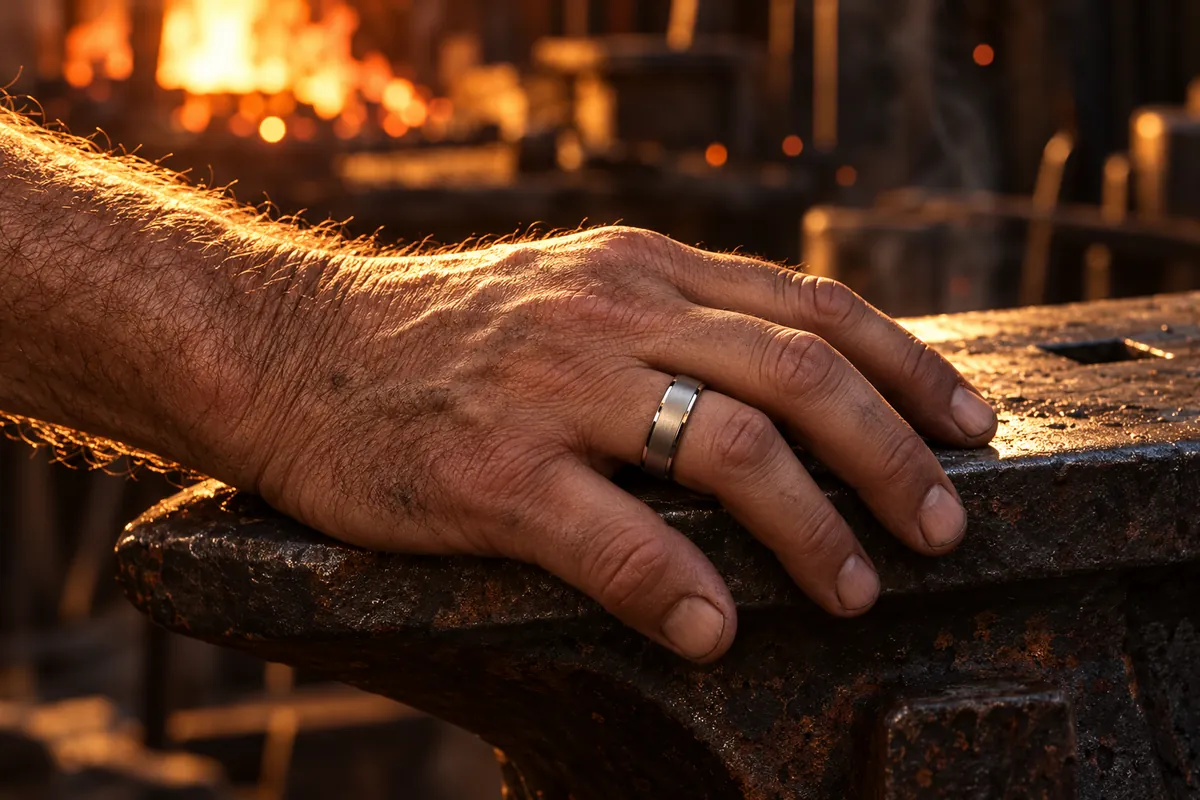
Platinum is one of the densest metals used in jewellery at 21.45 g/cm³. Titanium is 4.51 g/cm³. Make the identical band in both metals and the platinum one weighs roughly 4.8 times as much.
That is the thing most men notice first. Platinum feels substantial, and a lot of buyers read that heft as quality. Titanium is barely there — after a week most wearers forget it is on. If you have never worn a ring, or you work with your hands all day, light is the easier adjustment. If you want to feel the ring, platinum delivers that in a way titanium never will.
Price: platinum costs several times more, and here is why
Platinum is a precious metal traded by weight, like gold. Titanium is an industrial metal. Check the titanium rings and platinum rings categories for current pricing rather than trusting any number quoted in an article.
Three things stack up to create that gap:
- The metal costs more per gram. Platinum is a precious metal with a bullion market behind it; titanium is not.
- You need far more grams. Because platinum is 4.8 times denser, the same ring shape uses 4.8 times the mass of metal.
- It is harder to work. Platinum melts at 1,768 °C and needs specialist equipment and bench skill, which is priced into the finished ring.
Titanium’s accessible price comes from the metal itself: it is abundant and industrially produced, so you get a hard-wearing, lightweight ring without paying precious-metal prices.
Resizing: get the size right first
Our titanium rings cannot be resized. Platinum can be resized by a specialist jeweller. If your finger size is likely to change — you are mid weight-loss, your hands swell in summer, you work in the heat — that is a genuine argument for platinum.
It also means titanium sizing has to be right the first time. Use our ring sizer to measure at home over a few days rather than guessing from a chart, and in-stock rings can be exchanged within 60 days of delivery if the fit is wrong, and if your size changes years later, our Fit for Life policy lets you exchange a titanium or tungsten ring for a new size for a small fee. Wider bands sit tighter than narrow ones, so an 8mm ring usually needs a half size up on what a 4mm ring measures.
Platinum’s advantage runs beyond sizing: it can be re-tipped, re-shanked and laser-welded decades later. A platinum band is a repairable object. A titanium band earns its place differently: it stays hard-wearing for years with almost no care.
Allergies and nickel: both are safe bets
Neither metal contains nickel, the usual culprit in a jewellery rash. Nickel allergy is one of the most common causes of contact allergic dermatitis and rings are a listed source, so this matters more than most buyers realise.
Titanium is biocompatible — the same reason it is used for orthopaedic and dental implants — and titanium very rarely causes reactions, even for many wearers who react to other jewellery metals. Platinum jewellery is Pt950, alloyed with iridium, cobalt or ruthenium; none of those is nickel. If you have a known cobalt sensitivity, ask which Pt950 alloy a ring uses. Both metals resist corrosion, including in salt water, so neither will discolour your finger.
Colour and patina: white shine vs grey that stays grey
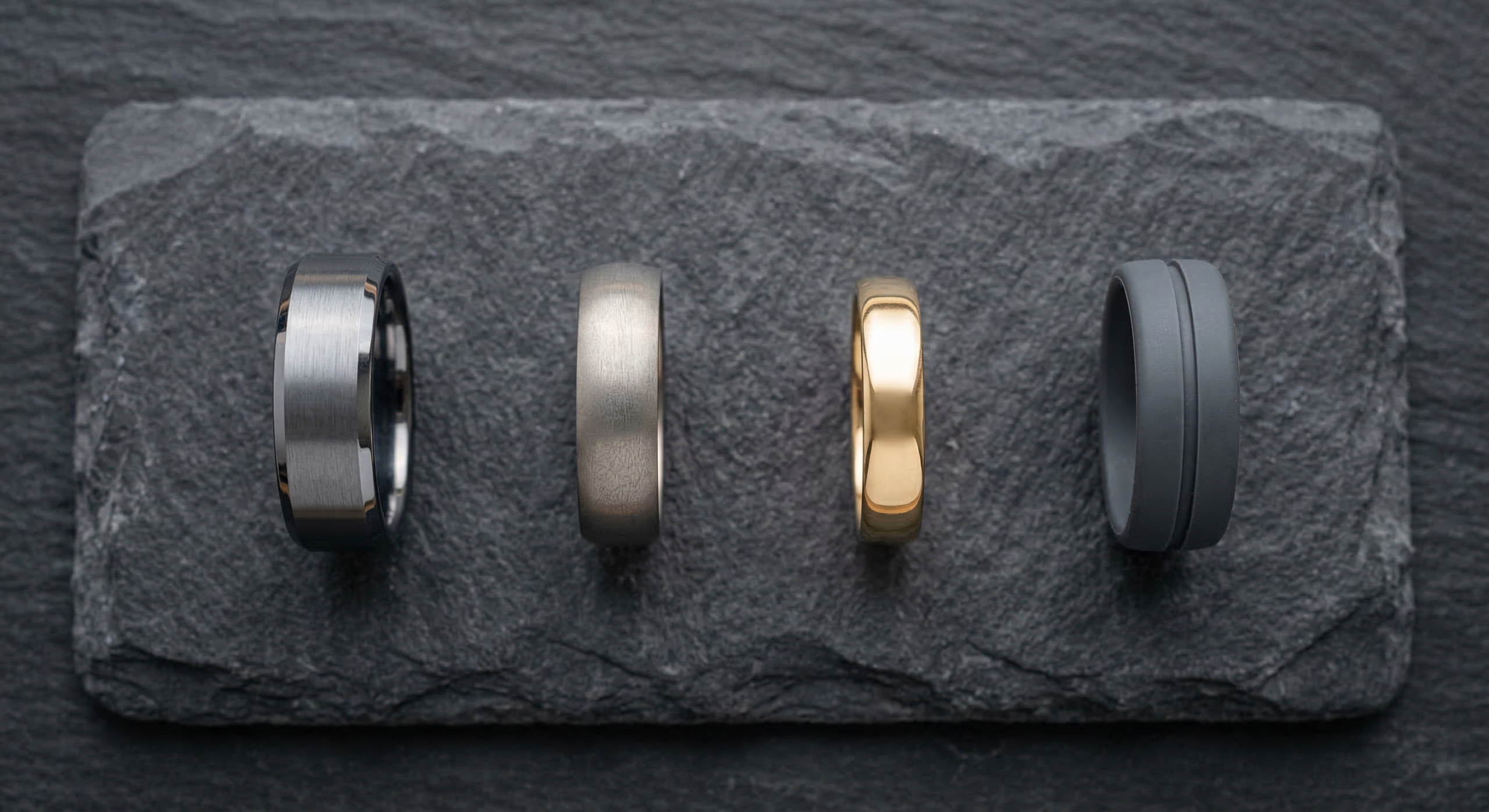
Platinum is naturally white and stays white — it does not need rhodium plating the way white gold does, and it does not tarnish. Titanium is a slightly darker, cooler grey. Side by side, platinum reads brighter and more formal; titanium reads more modern and industrial.
The real difference shows up over years. When platinum is scratched the metal is displaced rather than lost — the scratch pushes up ridges at its edges instead of removing material. Those thousands of tiny scratches blend into a soft matte finish known as a patina. It is why so many platinum bands are sold with satin, brushed or sand-blast finishes. If you hate it, a jeweller can polish it back to bright, repeatedly, over a lifetime.
Titanium does not patina in the same way. It keeps its grey and its finish, and takes far fewer marks to begin with.
Black and coloured titanium
Titanium can be anodised or coated, which platinum cannot. Anodising builds an oxide film on the surface using an electrolyte and around 100 volts of DC; the film’s thickness controls the colour, so no dyes are involved. We also carry a run of black rings, including black titanium. There is no equivalent for platinum — if you want a black ring, titanium (or tungsten) is the answer.
Emergency removal: both can be cut off
Both titanium and platinum rings can be removed in a hospital emergency. The myth that a titanium ring means a lost finger is wrong: titanium rings are “only slightly more difficult to cut off in case of emergency than for gold rings; titanium is comparable to steel in its resistance to sawing.”
Every material we stock has been tested for exactly this, including having rings in each material removed in the emergency room of a hospital — see our men’s ring metals guide for the full material-by-material comparison. If you are ever in that situation, tell the staff what the ring is made of so they reach for a saw-style cutter rather than a shear.
Durability over decades
The two metals fail in different ways, and that is the fair way to compare them over 30 years.
A titanium ring looks close to new for far longer: it resists scratching, does not tarnish, and needs nothing more than soap and water. What it cannot do is be repaired or altered. If it is badly damaged, or your finger changes size, it is replaced rather than fixed.
A platinum ring develops its patina over the years but loses almost no metal doing it, and everything about it can be restored. Antique platinum pieces come back to the bench a century on with their engraving and settings intact. That is what people mean by an heirloom metal.
Which one suits your work and your lifestyle
Trades, gym and hands-on work
Titanium, comfortably. It is harder, light enough to forget under gloves, and at its accessible price it is an easy ring to wear hard. Platinum’s patina builds faster on a work site, so many men who love platinum keep it for occasions. Plenty of tradies keep a silicone ring for the worst jobs and save the metal ring for weekends.
Office, formal and everyday non-manual work
Either works, and this is where platinum earns its money. At a desk the scratch difference barely registers, and platinum’s weight and white shine read as the more formal choice — especially next to a partner’s platinum or white-gold engagement ring.
Sensitive skin, or you have reacted to jewellery before
Both. Neither contains nickel. Titanium is the cheaper way to find out whether you can wear a ring at all.
Where tungsten fits
Tungsten carbide is the third metal most men compare against these two. It is harder and far more scratch-resistant than either, and heavier than titanium; like titanium, it cannot be resized. If maximum scratch resistance is your priority, look at tungsten rings instead.
The verdict
Choose titanium if you want the hardest-wearing of the two, you work with your hands, you have never worn a ring and want something you will not notice, you want black or a matte finish, you want a more affordable ring, or you simply want a ring you can wear without thinking about it. It keeps its size and shape, so measure properly first.
Choose platinum if you want a precious metal with resale and heirloom value, you want the weight on your finger, you want a ring that can be resized, repaired and restored for the rest of your life, you like the idea of a patina building over the years, or you are matching a platinum or white-gold engagement ring. It is a bigger investment, and it rewards you with a ring that can be resized and restored for life.
If money is not the constraint and your size is stable, most men are happier with titanium day to day and happier with platinum on the day. Some buy both.
Titanium rings we stock
A few of the titanium bands in our range:
- Titanium Polished Mens 6mm Wedding Band — the plain classic, if you want titanium doing the simplest possible job.
- Titanium Satin Finish Mens 6mm Wedding Ring — satin hides day-to-day marks better than a mirror polish.
- Titanium Thin Mens Wedding 5mm Ring Brushed Finish — narrower profile for smaller hands or a lower-key look.
- Titanium Wedding Ring With Solid 14k Gold Inlay — solid gold inlay for warmth, without gold-ring pricing.
- Black Titanium 7mm Mens Ring With Concave Centerline — the black option platinum cannot give you.
- Rosewood And Titanium 8mm Mens Ring — real timber inlay, still light on the finger.
Browse the full titanium rings range, or the wider men’s wedding rings collection if you are still deciding on metal. Get in touch through our Help Centre if you want a second opinion on sizing.
Frequently asked questions
Is titanium better than platinum?
Titanium is better on hardness, weight and price. It is roughly twice as hard as platinum (Mohs 6.0 vs 3.5), about a fifth of the weight, and costs far less. Platinum is better if you want a precious metal that can be resized and repaired for life.
Is platinum better than titanium?
Platinum is better if you value precious-metal status, resale value, the weight on your finger, and the ability to resize, repair and restore the ring decades later. It is not better for scratch resistance, comfort under manual work, or budget.
Which is stronger, titanium or platinum?
Titanium is harder; platinum is tougher. Titanium scratches less: Mohs 6.0 against platinum’s 3.5, and 160–200 HV for commercially pure Grade 2 titanium against 80–135 HV for the common Pt950 jewellery alloys. Platinum is more ductile, which makes it tougher for holding stone settings without cracking.
Is titanium or platinum more expensive?
Platinum is far more expensive. It is a precious metal sold by weight, and because it is about 4.8 times denser than titanium, the same ring shape needs about 4.8 times the mass of metal.
Which is heavier, a titanium or a platinum ring?
Platinum, by a long way. Platinum’s density is 21.45 g/cm³ and titanium’s is 4.51 g/cm³, so an identical band in platinum weighs about 4.8 times as much as the titanium version.
Can a titanium ring be resized?
No. Our titanium rings cannot be resized, so the size has to be right at the point of purchase. Use our ring sizer to measure at home over several days, and in-stock rings can be exchanged within 60 days of delivery if the fit is wrong, or later under our Fit for Life policy for a small fee. Platinum can be resized by a specialist jeweller.
Are titanium and platinum rings hypoallergenic?
Both are nickel-free, and nickel is the usual cause of a jewellery rash. Titanium is biocompatible and is used for orthopaedic and dental implants; platinum jewellery is Pt950 alloyed with iridium, cobalt or ruthenium. If you have a known cobalt sensitivity, ask which Pt950 alloy a particular ring uses.
Can a titanium ring be cut off in an emergency?
Yes. Titanium rings are only slightly more difficult to cut off in an emergency than gold rings, and titanium is comparable to steel in its resistance to sawing. Every material we stock has been tested for emergency removal, including having rings in each material removed in a hospital emergency room (see our men’s ring metals guide). Tell hospital staff what the ring is made of so they use a saw-style cutter.
Titanium or platinum for a wedding band?
Choose titanium for a hard-wearing, lightweight band at an accessible price, especially if you work with your hands or want a black or matte finish. Choose platinum for a precious, heavier band that can be resized and restored for life, or to match a platinum or white-gold engagement ring.
Sources
- Element hardness and density: Wikipedia, Titanium and Platinum.
- CP Grade 2 titanium, 160–200 HV: AZoM, Grade 2 Unalloyed Ti (“Pure”) 50A.
- Pt950 alloy hardness and platinum patina: Jurgen J. Maerz, Platinum Durability vs Scratching, Ganoksin.
- Emergency removal, biocompatibility, anodising: Wikipedia, Titanium ring.
- Nickel allergy: DermNet, Nickel allergy.