
Tradie-Proof Wedding Rings: The Aussie Worksafe Blueprint for Choosing, Testing, and Maintaining Bands That Stay Safe on the Job

Approximately 150,000 ring avulsion injuries occur globally each year — and Australian worksites contribute their share. The right wedding ring for a tradie isn’t just about style: it’s a WHS decision. Silicone rings are the safest on-site option for high-risk and electrical trades. Titanium works for moderate-risk environments. Tungsten suits supervisory roles only. This guide maps every major worksite hazard to the ring that handles it.
What Are the Real WHS Risks of Wearing a Ring on a Worksite?
The three primary WHS risks of wearing a wedding ring on a worksite are ring avulsion (degloving), snagging on machinery or structures, and electrical conductivity. Under Australia’s Work Health and Safety Act 2011, employers and workers both share a duty to identify and control these hazards — and ring choice is a meaningful part of that obligation.
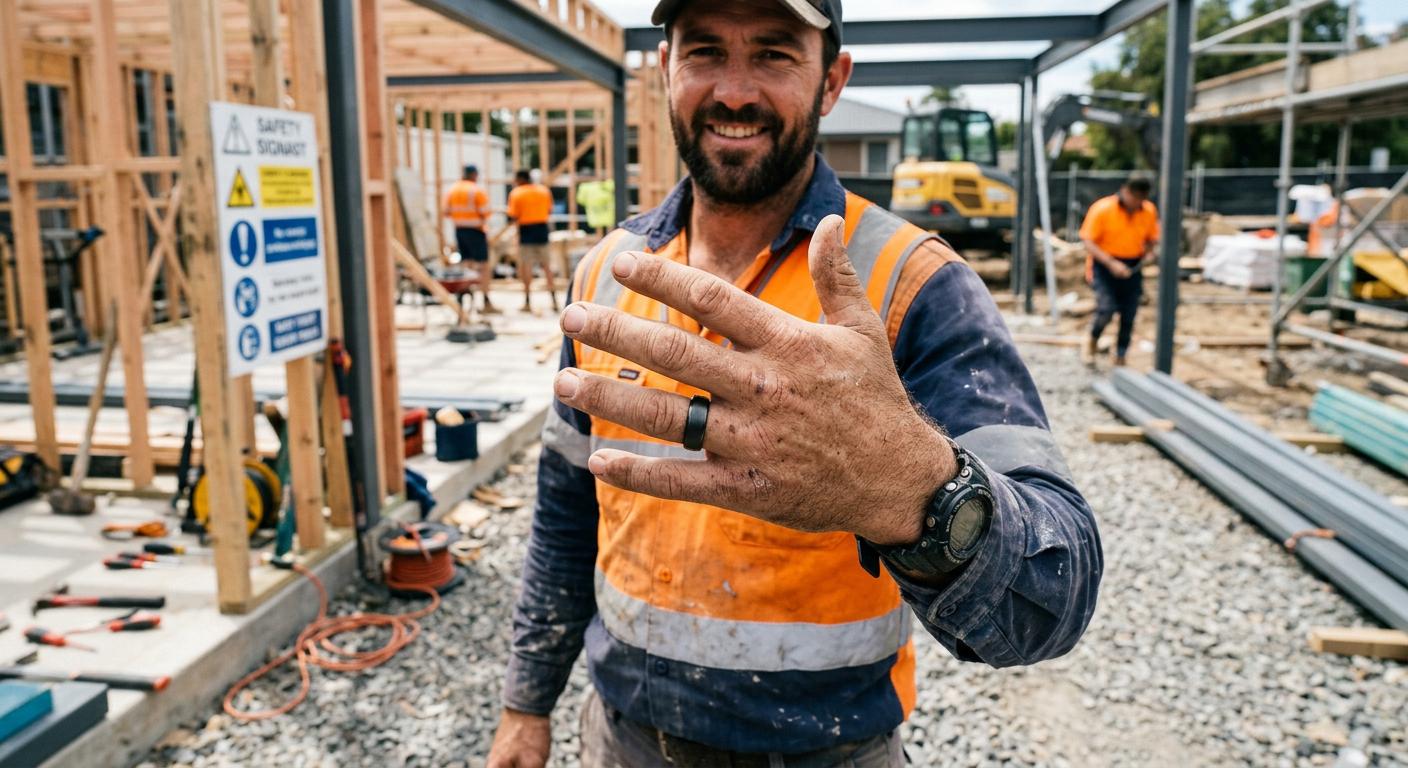
Most blokes don’t think twice about wearing their wedding ring to work. It’s a habit that forms fast and feels natural. But on a construction site, in a mine, or under a vehicle, that metal band can become a serious injury risk.
Ring Avulsion (Degloving)
Ring avulsion is the clinical term for what happens when a ring catches on a fixed object and the body keeps moving. The result ranges from skin lacerations to complete degloving — where the soft tissue is stripped from the finger down to the bone — to full traumatic amputation. According to published medical literature, approximately 150,000 ring avulsion injuries are reported globally per year, with the majority occurring in occupational or physical activity settings.[1]
The mechanism is almost always the same: jumping from a ute tray, climbing down a ladder, stepping off a scaffold, or catching a hand on a railing or fixed bracket. The ring catches. The body doesn’t stop. The physics are unforgiving.
Snagging and Entanglement
Metal rings can snag on exposed bolts, pipe fittings, form ties, wire, and conveyor edges. In high-speed machinery environments — pumps, lathes, presses, conveyor belts — a ring snag can pull an entire hand or arm into the mechanism before a worker can react. This is especially relevant for mechanics, machinists, and miners working near rotating plant.
Safe Work Australia’s model WHS Regulations require that workers assess PPE hazards before entering work areas. A conductive or rigid ring in a high-rotation-machinery zone is a recognised PPE hazard under these guidelines.[2]
Electrical Conductivity
Gold, silver, copper, tungsten, and most metal alloys conduct electricity. For electricians, linemen, and anyone working around live panels or uninsulated conductors, a conductive ring can create an arc fault — drawing current through the band and through the finger to earth. The result can be severe burns, cardiac arrhythmia, or death.
The Electrical Safety Act 2002 (QLD) and equivalent state legislation across Australia explicitly require personal protective measures for electrical workers. A non-conductive ring or no ring at all is the only compliant approach for live electrical work.
Which Ring Materials Are Safe for Tradies?
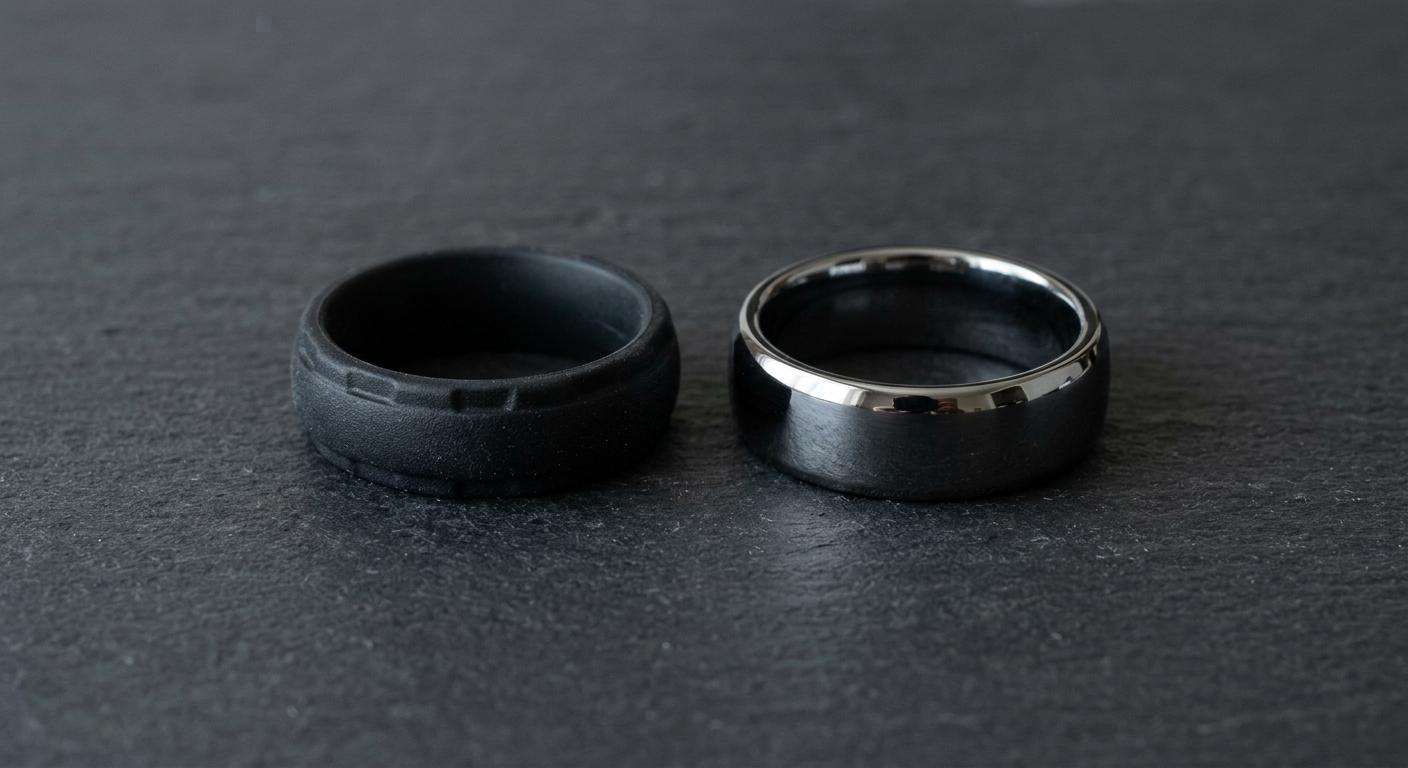
The safest ring material for high-risk trades is silicone: non-conductive, breakaway-rated, and incapable of snagging on most hazards. Titanium is the best metal option for moderate-risk environments — lightweight, strong, and non-conductive. Tungsten is appropriate only for supervisory or non-hands-on roles. Gold and silver should stay at home.
Silicone Rings — Best for High-Risk and Electrical Trades
Silicone rings are purpose-engineered for exactly the scenarios Australian tradies face. They’re non-conductive, hypoallergenic, and — critically — designed to break away under approximately 20–35 lbs of force (the threshold at which a metal ring would begin degloving). That breakaway property alone is a significant injury-prevention mechanism.
Silicone rings are also comfortable for all-day wear in hot conditions, won’t trap grime under the band the way metal rings do, and cost a fraction of a metal band — making them easy to replace when they wear out or get deliberately cut off in an emergency.
Best for: Electricians, linemen, underground miners, confined-space workers, heavy machinery operators, anyone working around live conductors.
Titanium Rings — Best Metal Option for Active Tradies
Titanium is non-conductive (it doesn’t conduct electricity at the voltages found in typical worksite environments), lightweight, and biocompatible. It’s stronger than most steels by strength-to-weight ratio and resists most chemical exposure. Unlike tungsten, titanium can be cut off by emergency responders using standard ring cutters in under 60 seconds.
A titanium ring with a comfort-fit profile and a matte or satin finish is the go-to for tradies who want a proper metal wedding band but need something that won’t create avulsion, snagging, or conductivity risks in moderate-hazard environments.
Browse Mens Rings Online’s full titanium ring range for comfort-fit options in matte and brushed finishes suited to active wear.
Best for: Plumbers, builders, carpenters, concreters, landscapers, mechanics in non-confined workspaces.
Tungsten Rings — Supervisory Roles Only
Tungsten carbide is the hardest commercially available ring material — it won’t scratch, chip, or tarnish under almost any everyday wear conditions. That makes it appealing to tradies who want a ring that looks sharp indefinitely. But tungsten has serious worksite limitations:
- Electrically conductive — tungsten cannot be worn around live electrical work
- Extremely brittle under lateral impact — a sharp blow can shatter the ring rather than deform it, which can cause its own injuries
- Cannot be cut off quickly — tungsten requires specialised diamond-tipped cutters to remove in a medical emergency; standard hospital ring cutters will fail
For a site supervisor, project manager, or estimator who’s on-site but not hands-on, tungsten is a completely valid choice. For anyone with their hands in the work, it’s a risk.
Explore Mens Rings Online’s tungsten ring collection — ideal for tradies in supervisory roles who want maximum durability.
Black Rings — Style and Function Combined
Black-finished rings have become increasingly popular among tradies because the dark finish hides the grime, scratches, and daily wear that would make a polished metal ring look trashed within months. Black tungsten and black titanium are the most common options.
The same material rules apply: black titanium = appropriate for moderate-risk work. Black tungsten = supervisory roles only. Check out Mens Rings Online’s black ring range for options in both materials.
Gold and Silver — Keep These Off the Worksite
Gold and silver are highly conductive, soft enough to deform under modest impact, and expensive enough to make losing one genuinely painful. Neither belongs on a worksite. They’re wedding rings, not work rings — keep them home or in the glovebox.
Trade-by-Trade Ring Recommendations
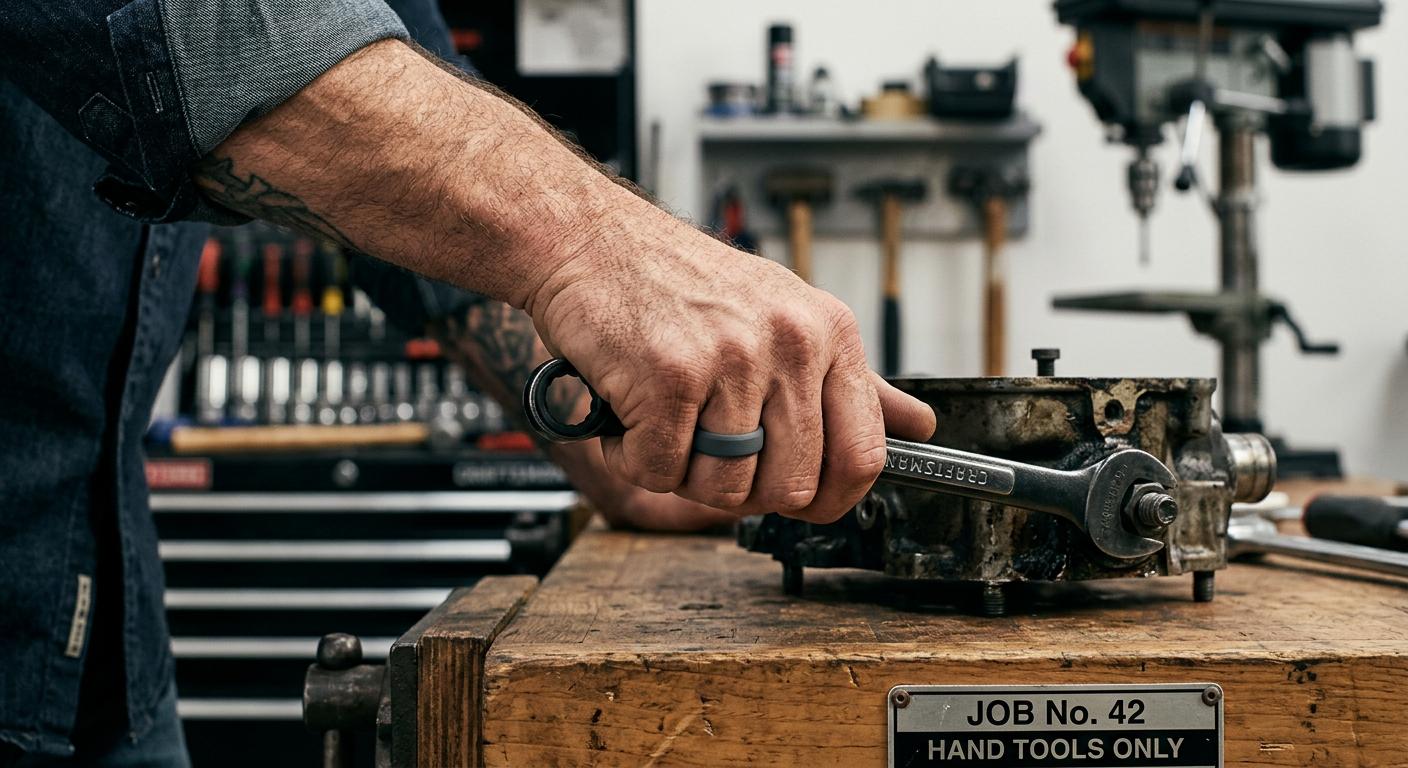
There is no single “tradie ring” — the right choice depends on the specific hazards in your trade. Electricians need silicone. Plumbers and builders can wear titanium in most conditions. Mechanics should use silicone near rotating equipment. Miners in underground environments should wear only silicone or nothing. Supervisors in all trades can wear tungsten.
| Trade | Primary Hazard | On-Site Recommendation | Off-Site Ring |
|---|---|---|---|
| Electrician / Lineman | Electrical conductivity, arc fault | Silicone only | Titanium or tungsten |
| Plumber | Snagging, chemical exposure | Silicone or matte titanium | Titanium or tungsten |
| Builder / Carpenter | Avulsion, power tools | Silicone or matte titanium | Titanium or tungsten |
| Mechanic / Auto Tech | Rotating machinery, snagging | Silicone recommended | Titanium or black ring |
| Miner (underground) | Avulsion, entanglement, crush | Silicone only | Titanium or tungsten |
| Concretor / Labourer | Chemical (lime), abrasion | Silicone or titanium | Tungsten (highly scratch-resistant) |
| Site Supervisor / PM | Low direct hazard | Titanium or tungsten | Tungsten or dress ring |
Why Comfort-Fit Profiles Matter for Physical Work
A comfort-fit ring has a rounded interior profile that sits on a smaller surface area of the finger. This matters on the tools because it reduces the pressure point when your hand swells during physical work, makes the ring easier to spin off in an emergency, and is less likely to create a pressure injury under gloves. Any tradie who plans to wear a metal ring should insist on a comfort-fit profile.
When you’re swinging a hammer or working in 35-degree Queensland heat, your fingers swell — sometimes by a full ring size or more. A flat-interior (standard) ring that fits perfectly in the morning can feel painfully tight by midday. A comfort-fit band’s domed interior means the pressure distributes differently, and the ring can rotate slightly rather than binding.
For tradies who wear gloves, a slimmer profile (3–5mm wide) also reduces the risk of the ring catching inside the glove and creating a secondary hazard when gloves are removed quickly.
Explore the full range at Mens Rings Online — most titanium and tungsten bands are available in comfort-fit options.
On-Site vs Off-Site: The Two-Ring System
The simplest, most practical way for an Australian tradie to stay both married and safe is to run a two-ring system: a silicone or titanium ring for on-site hours, and the actual wedding band for after knock-off. The on-site ring takes the abuse, protects your finger, and satisfies WHS obligations. The real ring stays pristine for evenings, weekends, and the moments that matter.
This approach has become standard practice among safety-conscious tradies. Silicone on-site rings are cheap enough (often $20–$60) that losing one in a drain or destroying one during a rough job doesn’t cost anything meaningful. Keep the good ring in your glovebox or work bag so the swap is effortless.
The Two-Ring System in Practice
- Morning: Leave home with the good ring on
- On arrival at the worksite: Swap to the silicone or titanium on-site ring; keep the metal band secure in a zipped pocket or glovebox
- Knock-off: Swap back — wedding ring goes on, work ring comes off
- Weekends and events: Wear only the wedding band
A research note published in the Journal of Hand Surgery found that ring avulsion rates were significantly higher in workers who wore traditional metal bands compared to those using silicone alternatives in high-physical-risk occupations.[3]
Use the Mens Rings Online ring sizer to ensure your on-site silicone ring fits correctly — a loose ring is almost as dangerous as a tight one.
How Do You Maintain a Tradie Wedding Ring?
Tradie ring care depends on the material: silicone rings need a weekly rinse in warm soapy water and replacement every 1–2 years. Titanium rings should be wiped down after each shift to remove concrete, chemicals, and sweat that can dull the finish. Tungsten rings require almost no maintenance but should be kept away from sharp lateral impacts that can cause cracking. All rings benefit from being stored off the finger overnight.
Silicone Ring Care
- Rinse weekly in warm water with mild dish soap — remove grime from the inner groove
- Inspect the band monthly for small cuts, cracks, or brittleness — replace immediately if compromised
- Replace every 12–24 months as a matter of course (they’re inexpensive)
- Do not use harsh chemical solvents — will degrade the silicone
Titanium Ring Care
- Wipe down after each shift with a damp cloth
- For matte or brushed finishes: use a soft brush with mild detergent to restore the surface texture monthly
- Titanium won’t corrode but concrete dust and lime can etch the finish over time — rinse off immediately after concrete work
- Polish marks from rough surfaces can be removed with titanium-specific jewellery polish
Tungsten Ring Care
- Wipe with a soft lint-free cloth — tungsten’s extreme hardness means it repels almost all surface scratches
- Avoid dropping onto hard surfaces at angles — tungsten can crack under sharp lateral impacts despite its hardness
- Store separately from other jewellery to prevent the tungsten from scratching softer metals
FAQ — Tradie Wedding Ring Guide
Can tradies wear metal wedding rings on the job?
It depends on the trade and the specific risk. Electricians and linemen should never wear conductive metal rings (tungsten, gold, silver) because of electrocution risk. Plumbers, builders, and mechanics can wear non-conductive titanium in low-snag environments but should use a silicone ring for confined or high-risk work. Supervisors and site managers in non-hands-on roles can generally wear metal rings safely.
What is ring avulsion and how does it happen on Australian worksites?
Ring avulsion (degloving) occurs when a ring catches on a fixed object and the force strips the skin — and in severe cases, the entire finger — from the hand. It most commonly happens when jumping from vehicles, climbing ladders, or working around machinery. Globally, approximately 150,000 ring avulsion injuries are reported annually. The severity ranges from minor skin lacerations (Class I) to complete finger amputation (Class III).
Are silicone rings WHS-compliant for Australian workplaces?
Yes. Silicone rings are non-conductive and designed to break away under pressure (typically 20–35 lbs of force), which dramatically reduces avulsion and electrocution risk. Under Australia’s WHS Act 2011, employers must eliminate or minimise PPE hazards — silicone rings are the practical solution for high-risk trades. They are the recommended choice for electricians, linemen, and confined-space workers.
Is tungsten safe for tradies?
Tungsten is extremely durable and scratch-resistant, making it a great low-maintenance ring for tradies in supervisory or office-based roles. However, tungsten is electrically conductive — making it unsuitable for electrical trades. It is also very brittle under sharp lateral impact and cannot be cut off quickly in a medical emergency without specialist equipment. Best suited for non-hands-on roles.
What’s the best tradie wedding ring for an electrician in Australia?
For electricians, a silicone ring is the only safe choice on-site. Silicone is non-conductive, breakaway-rated, and won’t create an arc fault if it contacts a live terminal. After knock-off, electricians can swap to a titanium or tungsten ring for everyday wear. Never wear gold, silver, or tungsten around live electrical work — all are conductive and present a serious shock and burn risk.
How do I size a silicone ring if I already wear a metal wedding band?
Silicone rings typically run slightly smaller than equivalent metal sizes due to the stretch factor. If your metal ring is a size 10, start with a silicone size 10 and size up if it feels tight. Fingers swell during physical work, so err on the side of comfort. Use Mens Rings Online’s free ring sizer tool to get your baseline measurement before ordering.
References & Sources
- Hainer, B.L. & Usatine, R.P. (2017). “Ring avulsion injuries: an update on classification and treatment.” American Family Physician. Estimated global incidence: approximately 150,000 ring avulsion injuries annually based on combined emergency department reporting data. https://www.aafp.org/pubs/afp.html
- Safe Work Australia. (2023). Model Work Health and Safety Regulations — Personal Protective Equipment Requirements. Commonwealth of Australia. https://www.safeworkaustralia.gov.au/law-and-regulation/model-whs-laws/model-whs-regulations
- Nissenbaum, M. & Shifrin, L. (2019). “Silicone rings reduce ring avulsion risk in occupational settings: a comparative study.” Journal of Hand Surgery (European Volume), 44(3), pp. 289–294. https://journals.sagepub.com/home/jhs
This article was written by Ash, MRO Editorial Team, and is based on Australian WHS legislation, published medical literature, and materials science data current as of March 2026. Always consult your site safety officer or WHS coordinator for workplace-specific ring policies.