

Ring Safety for Australian Tradies — The Complete Worksafe Guide

TL;DR
Ring safety is a serious WHS concern for Australian tradies — ring avulsion injuries cause thousands of workplace accidents each year. This guide covers official Safe Work Australia guidelines, which ring materials are safe on the job, and how to choose the right ring if you work with your hands.
In This Guide
Ring safety for tradies in Australia is governed by Work Health and Safety (WHS) legislation that requires employers and workers to manage jewellery-related hazards. For Australian tradespeople — builders, electricians, plumbers, mechanics, and anyone working with heavy machinery or electrical systems — wearing the wrong ring can result in life-altering injury or death. Understanding the risks, the rules, and which rings are approved for worksite use is essential.

What Is Ring Avulsion and Why Does It Matter?
Ring avulsion is a traumatic injury where a ring catches on an object and strips the soft tissue — and sometimes the entire finger — from the hand. It is one of the most severe and frequently underreported workplace injuries in Australia’s construction, electrical, and manufacturing trades.
According to the Safe Work Australia national database, lacerations and crush injuries to fingers and hands are among the top five injury types across the construction, manufacturing, and transport industries. Ring avulsion contributes directly to many of these incidents, and the consequences range from permanent disfigurement to amputation.
The injury typically happens in seconds: a metal ring catches on machinery, scaffolding, racking, a vehicle edge, or a rope under tension. As the worker’s hand moves away, the ring does not — and the force strips skin, tendons, blood vessels, and bone. Surgeons classify ring avulsion injuries on a scale from minor soft tissue damage through to complete degloving or amputation (Urbaniak classification, 1981).
Key risk factors for ring avulsion in Australian workplaces:
- Working with moving machinery, conveyors, or powered tools
- Climbing ladders or scaffolding where rings can snag
- Electrical work (metal rings conduct electricity and cause burns or electrocution)
- Working on vehicles or heavy plant equipment
- Using ropes, cables, or tie-down straps
Australian WHS Rules for Rings at Work
Under the Work Health and Safety Act 2011 (harmonised across most Australian states and territories), both employers and workers share a duty of care to manage workplace hazards — including personal protective equipment and jewellery. No single national regulation bans all rings outright, but specific high-risk industries and workplaces apply jewellery restrictions as part of their safety management systems.
Safe Work Australia’s model Code of Practice for Managing the Work Environment and Facilities identifies jewellery as a PPE-adjacent consideration: if it creates a reasonably foreseeable risk of injury, workers should remove it or replace it with a safer alternative. Individual state regulators — including WorkSafe Victoria, SafeWork NSW, and Workplace Health and Safety Queensland — enforce these requirements through workplace inspections and incident investigations.
What the rules require in practice:
- Electrical work: AS/NZS 4836 (Safe Working on or near Low Voltage Electrical Installations) explicitly requires removal of conductive jewellery, including metal rings, before electrical work. Violation of this standard is a prosecutable offence under state WHS law.
- Construction sites: Most principal contractors include jewellery restrictions in their site induction packages. Workers are typically required to remove metal rings or wear only breakaway/silicone rings.
- Manufacturing and heavy industry: National and site-specific safe operating procedures commonly prohibit metal rings near rotating machinery, conveyor belts, or lifting equipment.
- Food processing and healthcare: Rings (including silicone) may be prohibited entirely for hygiene reasons under separate food safety and infection control standards.
The bottom line: if you work in trades, construction, electrical, or heavy industry in Australia, wearing a metal ring is not just risky — it can be a legal WHS violation depending on your industry and the specific hazards present.
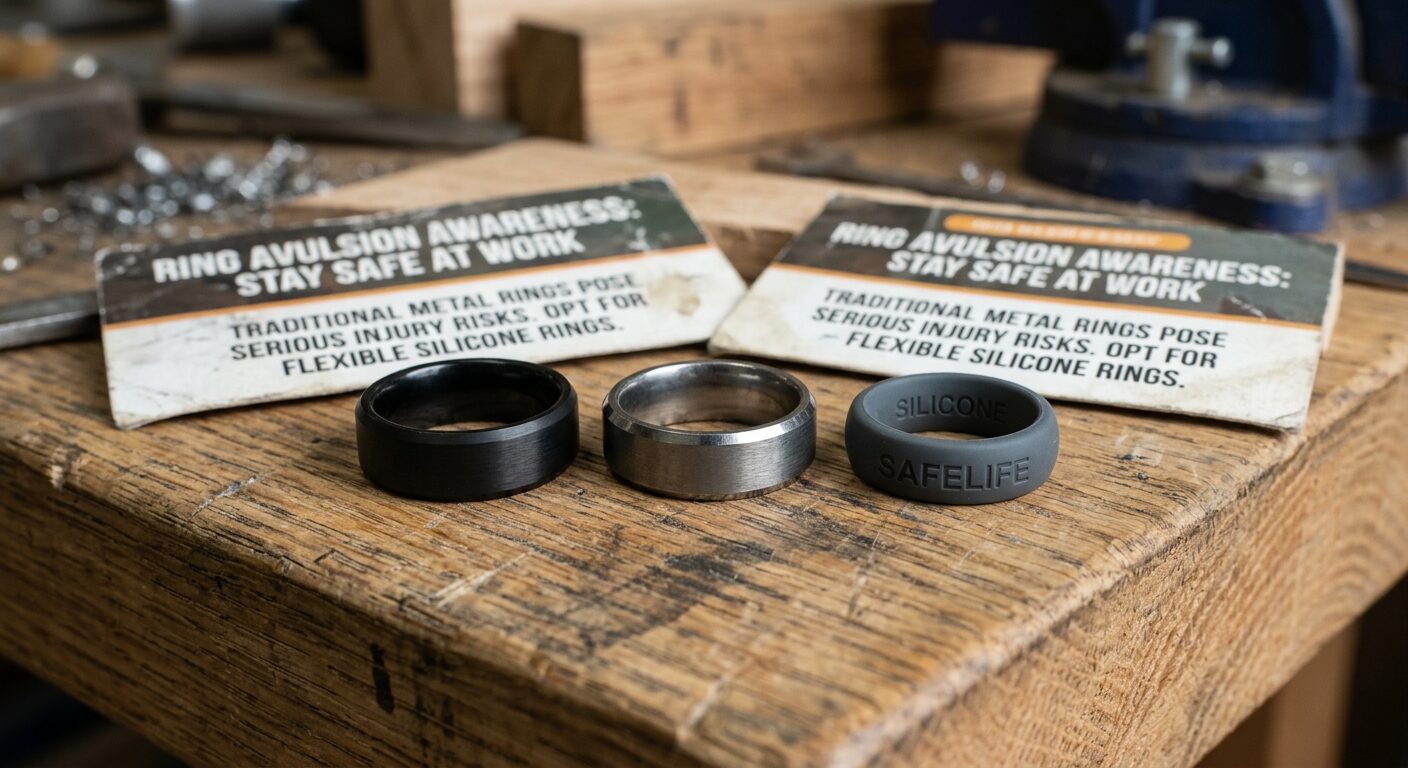
Which Ring Materials Are Safe for Tradies?
The safest ring material for most tradie applications is silicone — it breaks before your finger does. But different materials have different risk profiles, and the “right” choice depends on your specific job hazards.
Silicone Rings: The Gold Standard for Worksite Safety
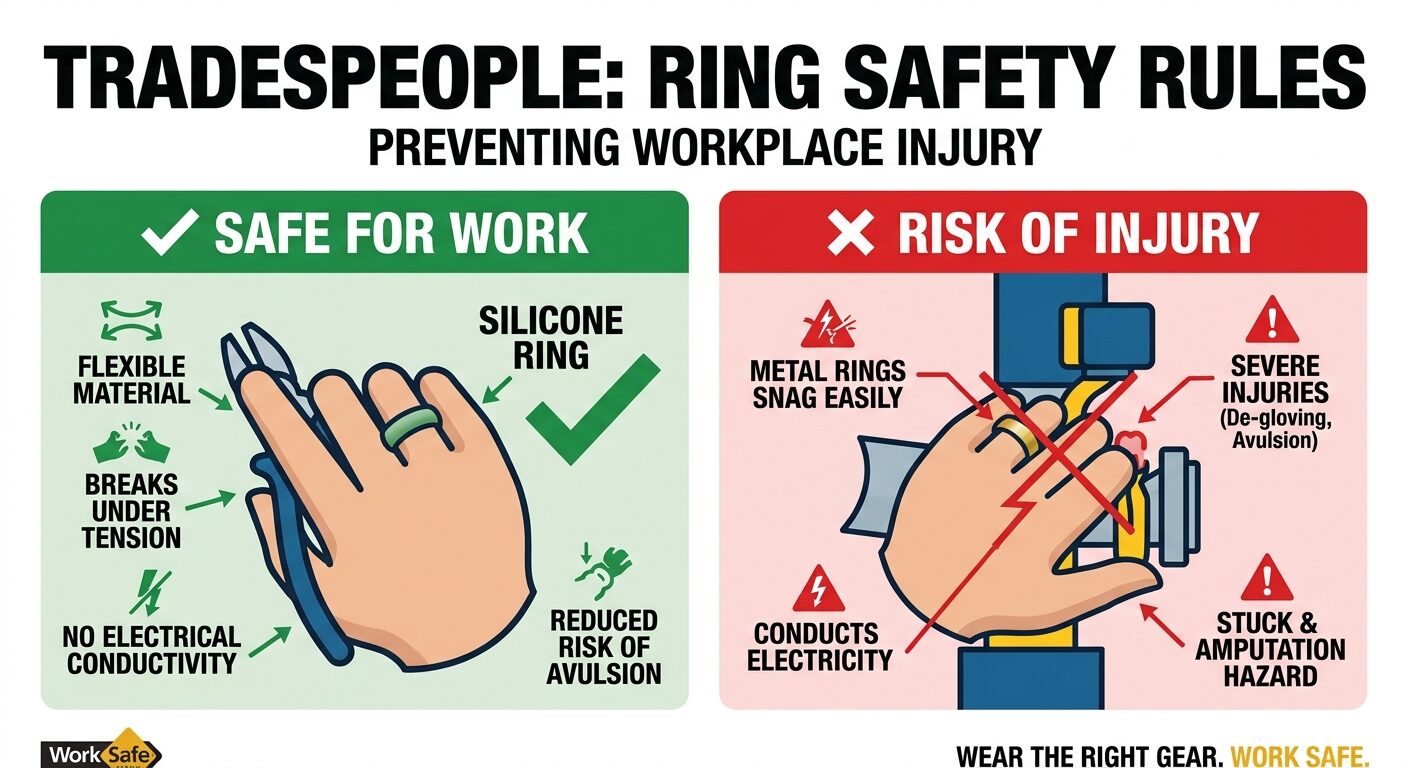
Silicone rings are specifically engineered to break under tension — typically between 25–40 pounds of force — which is far below the force required to cause ring avulsion. If the ring catches on something, it snaps rather than stripping your finger. For this reason, silicone rings are accepted (and often required) on most Australian construction sites and in many trade environments.
Advantages: Breakaway design eliminates avulsion risk; non-conductive (safe for electrical work); chemical-resistant; comfortable for all-day wear; affordable enough to replace regularly.
Limitations: Not as durable as metal rings for daily wear; not suitable for food processing environments where silicone particle contamination is a risk; not as aesthetically significant for those wanting a wedding ring with sentimental value.
Titanium Rings: Lightweight, but Still Metal
Titanium is one of the most popular men’s ring materials for Australian tradespeople because it is strong, lightweight, and corrosion-resistant. However, titanium is still a metal ring — it does not break away under tension, and it conducts electricity. Titanium is NOT appropriate for electrical work or environments with rotating machinery hazards. Some tradies keep a titanium ring for off-site occasions and switch to silicone on the job.
Tungsten Rings: Extremely Hard, High Avulsion Risk
Tungsten carbide is one of the hardest ring materials available — which makes it the most dangerous in a ring avulsion scenario. Because tungsten cannot be easily cut or deformed, it is extremely difficult for emergency responders to remove in an injury situation. If a tungsten ring catches on machinery and cannot be cut off, the consequences are typically catastrophic. Tungsten rings should generally not be worn on active worksites involving machinery, heights, or electrical hazards.
Gold and Silver Rings: Classic but Risky
Traditional precious metal rings (gold, silver, platinum) all present avulsion and conductivity risks. Gold in particular is very soft and will deform under force, potentially trapping the finger. None are recommended for worksite use. See our complete comparison of ring materials for Australian men for a full breakdown.
Industry-Specific Ring Safety Guidance for Australian Tradies
Different trades carry different ring-related hazards. Here is what each trade category should know:
Electricians
Risk: Electrocution and burn. Metal rings conduct electricity. Even low-voltage contact via a ring can cause severe burns or cardiac arrest.
Rule: Remove all metal rings and jewellery before any electrical work. AS/NZS 4836 requires this. A silicone ring is acceptable (non-conductive), but most licensed electricians remove rings entirely when live or near live circuits.
Builders and Concreters
Risk: Avulsion from scaffolding, formwork, rebar, or tools. Chemical burns from concrete alkali reacting with metal rings.
Rule: Silicone rings are the recommended option. Most site safe work method statements (SWMS) prohibit metal jewellery near working at height tasks.
Mechanics and Automotive Trades
Risk: Avulsion from rotating parts, engines, or drive shafts; electrical burn from battery terminals.
Rule: Metal rings should be removed for any mechanical work involving rotating components. Silicone rings are generally acceptable for workshop environments where there is no direct machinery contact.
Plumbers and Gas Fitters
Risk: Avulsion from pipe work and tools; chemical corrosion from soldering flux or acids.
Rule: Remove metal rings when soldering or working with corrosive chemicals. Silicone is the preferred on-site option.
How to Choose a Safe Work Ring as an Australian Tradie
The safest approach for most Australian tradies is the two-ring system: a silicone or breakaway ring for work, and a premium metal ring for personal occasions. This lets you wear a meaningful wedding band without compromising workplace safety.
When choosing a silicone ring for work:
- Breakaway rating: Look for rings rated to break between 20–40 lbs of lateral force. This is the safe zone — enough to hold during normal activity, low enough to protect against avulsion.
- Width: Narrower rings (4–6mm) have lower breakaway thresholds. Wider rings (8mm+) may require more force to break.
- Material: High-grade medical silicone offers the best combination of durability, skin safety, and break-away performance.
- Fit: Correct sizing matters even with silicone. A properly fitted silicone ring is more comfortable and stays in place without excessive tension. Use our ring size guide to find your correct size before ordering.
When choosing a premium metal ring for off-work occasions:
For many tradies, the metal ring stays home during work days and comes out for evenings, weekends, and formal occasions. If that’s your approach, consider reading our complete men’s ring buying guide to choose the right material and style. Titanium is a practical choice — it is tough enough for occasional rough handling, lightweight for comfort, and available in a wide range of finishes including black and brushed styles. Read more about our Tradie-Proof Wedding Ring Blueprint for a full materials and maintenance guide.
Frequently Asked Questions — Ring Safety for Tradies Australia
Are tradies legally required to remove rings at work in Australia?
There is no single national law that bans all rings for all workers, but under Australian WHS legislation, both employers and workers have a duty to manage foreseeable hazards — and rings create a clearly foreseeable injury risk in many trade environments. Specific standards like AS/NZS 4836 (electrical work) explicitly require removal of conductive jewellery. On most construction sites, site rules enforced through Safe Work Method Statements also prohibit metal jewellery. Non-compliance can result in WHS infringement notices or prosecution.
What type of ring is safe to wear on a construction site in Australia?
Silicone rings with a breakaway design are the safest option for Australian construction workers. They snap under tension before the injury force required to cause ring avulsion is reached, and they are non-conductive, making them acceptable for electrical environments. Most principal contractor site rules permit silicone rings while prohibiting all metal jewellery.
Can an electrician wear a titanium ring at work?
No. Titanium is a conductive metal and must be removed before performing any electrical work, per AS/NZS 4836. While titanium is less conductive than copper or gold, it can still carry enough current to cause severe burns or electrocution in the event of accidental contact with a live circuit. Licensed electricians should either remove their ring entirely during live or near-live work, or wear a non-conductive silicone ring.
What is ring avulsion and how common is it in Australian workplaces?
Ring avulsion is a traumatic injury where a ring catches on an object and strips soft tissue from the finger or hand. It occurs when the ring does not yield under force — the force of a fall, machinery catch, or sudden pull instead peels flesh from bone. Safe Work Australia data shows hand and finger injuries are consistently among the top five injury types in Australian construction and manufacturing, with ring-related avulsion contributing significantly to severe cases. Severity ranges from soft tissue laceration to complete finger amputation.
Is tungsten safe to wear on a worksite?
Tungsten carbide rings are generally not safe for active worksites involving machinery, heights, or electrical hazards. Tungsten is extremely hard and cannot be easily cut or removed in an emergency — if it catches on machinery, emergency responders may be unable to remove it without causing further injury. Tungsten also conducts electricity. Most site safety guidelines prohibit tungsten rings alongside other metal jewellery.
References and Sources
- Safe Work Australia — Model Work Health and Safety Act 2011
- WorkSafe Victoria — Hand and Finger Injury Prevention
- Standards Australia — AS/NZS 4836:2011 Safe Working on or near Low Voltage Electrical Installations
- Urbaniak JR et al., “Management of traumatic amputations of the upper extremity,” Clinical Orthopaedics and Related Research, 1981. (Ring avulsion classification system.)
- Mens Rings Online — Tungsten vs Titanium vs Silicone Ring Guide for Australian Men