

Table of Contents
Men's ring sizes in Australia: the short answer
Australian men’s ring sizes use letters (P, R½, T½, Z+2). US sizes use numbers (8, 9, 10, 13½). Both describe the same thing: the inside diameter of the band in millimetres. Across the last twelve months of orders, the single most common size we ship is a US 10 (T½) — an inside diameter of 19.84 mm — and about 85% of our ring orders fall between US 8 and US 13 (P to Z+1).
The chart below converts between all three. Under it are three ways to measure at home, what ring width and comfort fit do to the size you need, and why a tungsten or titanium ring has to be right the first time.
Men's ring size chart — Australian letter, US number and inside diameter (mm)
Find your inside diameter in millimetres and read across, then click through to everything we stock in that size. This is the conversion our product size options use, so what you read here is what you order.
| AU / UK letter | US size | Inside diameter (mm) | Inside circumference (mm) | Shop this size |
| J | 5 | 15.70 | 49.3 | Shop size 5 |
| K | 5.5 | 16.10 | 50.6 | Shop size 5.5 |
| L | 6 | 16.51 | 51.9 | Shop size 6 |
| M | 6.5 | 16.92 | 53.2 | Shop size 6.5 |
| N½ | 7 | 17.35 | 54.5 | Shop size 7 |
| O | 7.5 | 17.75 | 55.8 | Shop size 7.5 |
| P | 8 | 18.19 | 57.1 | Shop size 8 |
| Q | 8.5 | 18.53 | 58.2 | Shop size 8.5 |
| R½ | 9 | 18.89 | 59.3 | Shop size 9 |
| S½ | 9.5 | 19.41 | 61.0 | Shop size 9.5 |
| T½ | 10 | 19.84 | 62.3 | Shop size 10 |
| U½ | 10.5 | 20.20 | 63.5 | Shop size 10.5 |
| V½ | 11 | 20.68 | 65.0 | Shop size 11 |
| W½ | 11.5 | 21.08 | 66.2 | Shop size 11.5 |
| Y | 12 | 21.49 | 67.5 | Shop size 12 |
| Z | 12.5 | 21.89 | 68.8 | Shop size 12.5 |
| Z+1 | 13 | 22.33 | 70.2 | Shop size 13 |
| Z+2 | 13.5 | 22.75 | 71.5 | Shop size 13.5 |
| Z+3 | 14 | 23.16 | 72.8 | Shop size 14 |
| Z+4 | 14.5 | 23.4† | 73.6† | Shop size 14.5 |
| Z+5 | 15 | 23.8† | 74.8† | Shop size 15 |
| Z+6 | 15.5 | 24.2† | 76.1† | Shop size 15.5 |
| Z+7 | 16 | 24.6† | 77.4† | Shop size 16 |
† Sizes Z+4 and up are not on our printed chart. The diameters shown are calculated from the ISO 8653 relationship (inside diameter in mm = 0.8128 × US size + 11.63) published in the Wikipedia ring size reference, and land within about 0.15 mm of our own published figures across the rest of the range. We stock up to Z+9 (US 17) in some styles.
Circumference is simply the diameter multiplied by 3.14, so if you measured your finger with string you want the circumference column. If you measured the inside of an existing ring, you want the diameter column.
Letter charts vary — the millimetre figure does not
Two jewellers can hand you two different letters for the same finger. Different charts round the letter-to-number crossover differently — sometimes by half a letter at the top and bottom of the men’s range. The inside diameter in millimetres is the number that never moves, so if you know your diameter you can ignore the letter entirely.
This is also why we lead with the US number. The gap between a US 8 and 8.5 is about 0.35 mm of diameter; the gap between an Australian Q and Q½ is roughly half that — small enough that your finger can cross it walking from a hot car park into an air-conditioned shop.
Millimetres on a ring: width is not size
If you have seen “8mm” on a ring listing, that is the band width — how much of your finger the ring covers — not your size. Men’s bands run roughly 4 mm to 10 mm wide, while size diameters run 15 mm to 25 mm. A 6 mm and an 8 mm ring, both in a US 10, are the same size around your finger. Our guide on choosing the right ring width for your hand covers which width suits which hand.
What is the average men's ring size in Australia?
A US 10 — T½ in Australian letter sizing, 19.84 mm inside diameter. That is not a rule of thumb: it is the most-ordered size across the last twelve months of our own orders, ahead of US 11, US 9 and US 12 in that order. About 85% of orders sit between US 8 and US 13 (P to Z+1).
That makes a US 10 the least-bad guess if you are buying a surprise gift and have no way to measure — but it is still a guess, and the other 15% of men are nowhere near it.
Finger size tracks hand size and build rather than height, so a tall man with narrow hands can easily be a US 9 while a shorter man on the tools measures a US 12. Pinky rings are a different question again, and run well below your ring-finger size — see our average men’s pinky ring size guide.
Three ways to measure your ring size at home
1. Use a free ring sizer (most accurate)
This is the method we recommend, and it is the only one that measures your actual finger with a tool built for the job. Our plastic ring sizer is free and we post it anywhere in Australia — order a free ring sizer here. The steps are below.
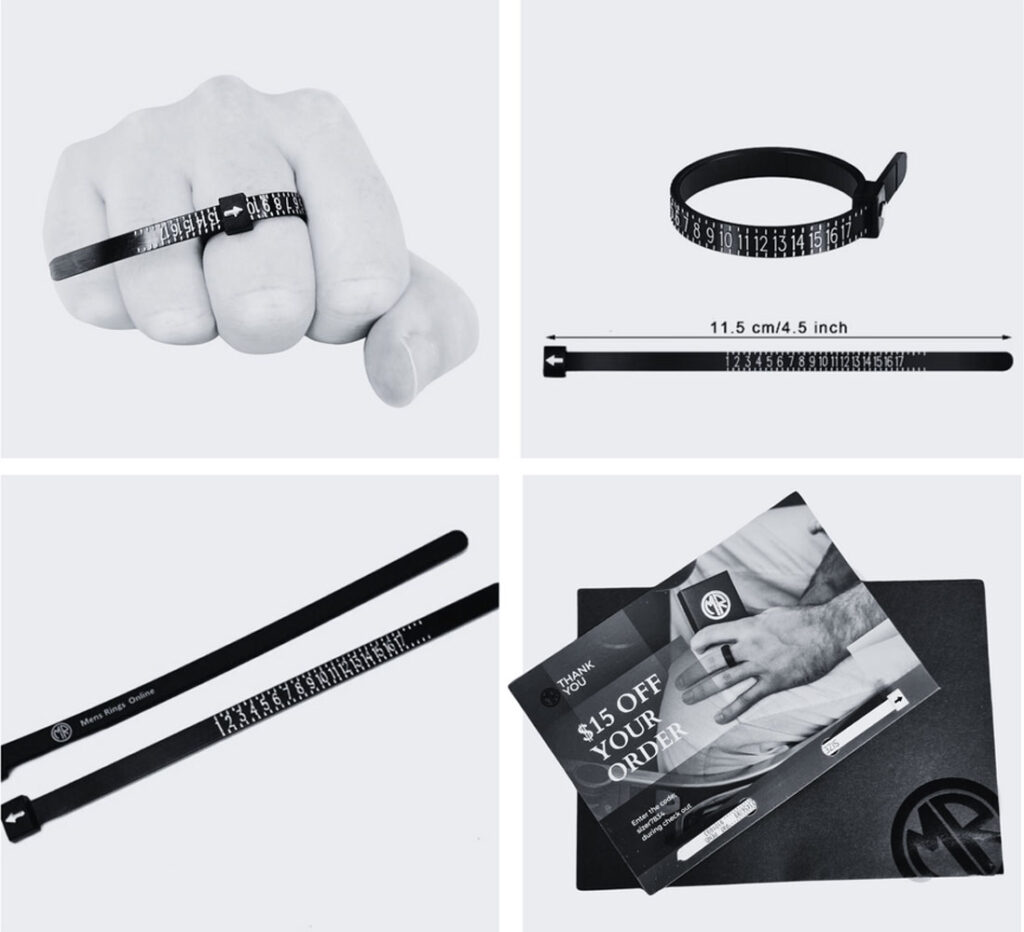
How Do I Use The Ring Sizer?
- Wrap the ring sizer around the ring finger;
- Insert the pointed end through the loop;
- Tighten the sizer on the finger until comfortable;
- Take the sizer on and off as if you were doing so with a ring;
- Loosen or tighten as necessary;
- Once you have the right fit, check the number the arrow is pointing at (if it is between numbers, then this is a half size);
- Done!
Measure two or three times across a day rather than once. Take the average, and if two readings disagree, go with the larger one.
2. Measure a ring he already wears
If you have a ring that already fits the right finger, you can size from it without involving him at all — useful for a surprise wedding or anniversary ring.
- Lay the ring flat on a ruler or a printed millimetre scale.
- Measure the inside edge to inside edge, straight through the centre. Do not include the metal.
- Read that figure in the inside-diameter column of the chart above.
Two cautions. Measure the ring he wears on the same finger of the same hand — the dominant hand commonly measures larger, often by around half a size. And if the borrowed ring is much wider or much narrower than the one you are buying, apply the width adjustment below.

3. String, floss or a paper strip
The fallback when you need an answer tonight. Wrap non-stretchy string, dental floss or a thin strip of paper around the base of the finger, mark where it overlaps, lay it flat against a ruler and read the length in millimetres. That length is your circumference — match it in the circumference column of the chart above.
It is the least accurate of the three, because string tension is guesswork and paper can dig in. Wrap it snug, not tight, and repeat three times to check you get the same number.
What does not work: online “print this ruler” charts printed at the wrong scale, and phone-screen ring sizers. Both are out by whatever your printer or screen scaling does, which is usually enough to cost you a size.
How to use string to quickly work out your ring size
While not as accurate as using our ring sizer, a quick way of measuring your ring size immediately is to use the string method. Click the button below to learn how and also use our free string method sizing calculator.
Ring Measuring Tool (if you have a ring but don't know it's size)
We created the following tool for those who already have a ring that fits well, but aren’t sure of or can’t remember the size. Please note: this works best on desktop or laptop computers.
2. Hold your ring against the circles below to find your size.
-
-
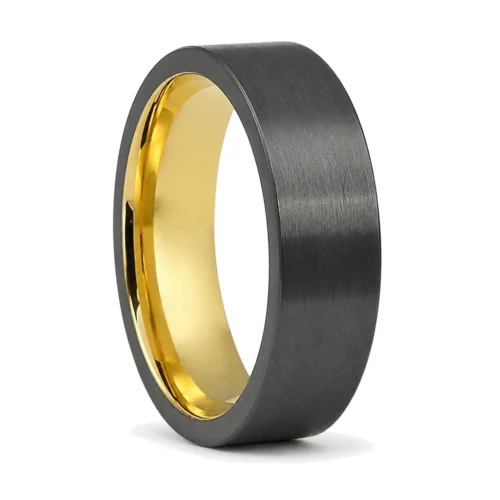

Black Tungsten 8mm Mens Ring With Gold Inner Band
★★★★★★★★★★(41)Rated 4.98 out of 5Mr. Centauri$239.00 – $289.00Price range: $239.00 through $289.00Select options This product has multiple variants. The options may be chosen on the product page -
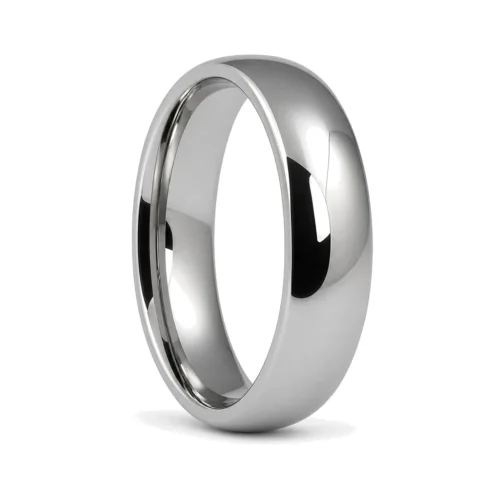

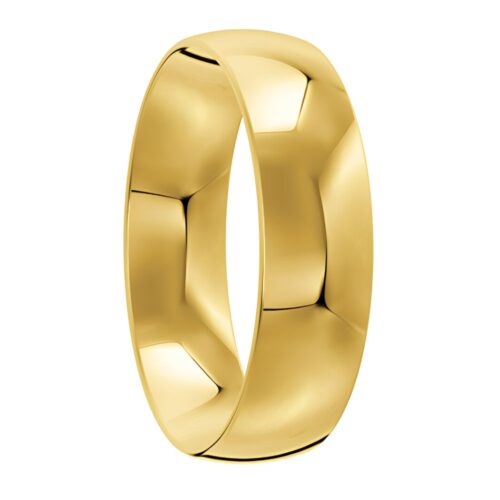
High Polished 6mm Mens Tungsten Wedding Ring
★★★★★★★★★★(68)Rated 4.93 out of 5Mr Reliable$239.00Select options This product has multiple variants. The options may be chosen on the product page -
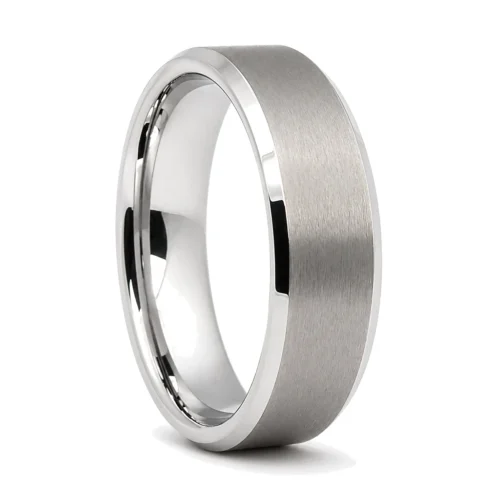

Mens Brushed Tungsten 6mm Wedding Ring
★★★★★★★★★★(32)Rated 4.97 out of 5Mr Challenger$239.00Select options This product has multiple variants. The options may be chosen on the product page
Ring width and comfort fit change the size you need
A wider band fits tighter at the same size. More metal sits against your finger, so there is more friction going over the knuckle and less room for your finger to swell into. As a rule of thumb, from about 8 mm wide, many men go up half a size from what a narrow sizer tells you. At 6 mm and under, order the size you measured.
Comfort fit pushes in the other direction. Most of our metal bands are comfort fit — the inside of the band is domed rather than flat, so it rolls over the knuckle instead of catching on it — and the product page tells you which ones are. If you are used to a traditional flat-inside band, a comfort-fit ring in your usual size can feel loose, and some men take half a size smaller in comfort fit.
The two adjustments partly cancel out. If you are buying a wide comfort-fit band, the honest answer is to measure with the sizer, order your measured size, and use the exchange window if it is not right. Do not stack both adjustments.
Knuckles, swelling and the time of day you measure
A ring has to pass your knuckle and then stay put at the base. If your knuckle is noticeably larger than the base of your finger, size to the knuckle — a ring you cannot get on is useless — and accept a slightly looser sit, or choose a wider band, which fills the gap better and spins less.
Fingers change size through the day and through the year:
- Morning: smallest, especially in cold weather. Do not size here.
- Late afternoon and evening: largest. Sizing at the end of a normal working day gives you the size that will still be comfortable at the worst moment.
- Heat, exercise, salty food, alcohol and long flights all swell fingers, sometimes noticeably.
- Summer versus winter can be worth up to half a size in most of Australia — a ring that fits in July can feel tight in January.
Measure at three different times across one day and take the largest comfortable reading. If you work outdoors, on the tools, or in a hot environment, weight that towards the afternoon reading. There is more on this in our guide to getting the right ring size when your fingers swell.

Why size matters more with tungsten and titanium
Neither tungsten nor titanium rings can be resized. This is not a policy, it is the material. Tungsten carbide is far too hard to cut, stretch or solder — it is pressed and machined to a finished size, and in a genuine emergency it is safely removed rather than resized. Titanium is technically weldable but not by conventional jewellery methods, and no high-street jeweller will stretch or shrink it.
The practical consequences:
- Tungsten rings and titanium rings must be ordered in the right size, or exchanged for a different size. There is no middle option.
- Custom-made rings in these metals generally cannot be exchanged either, so a custom order is the one time it is worth being genuinely certain before you click.
- Precious metals — gold, silver, platinum — can be resized by any local jeweller, so the stakes are lower there.
- Silicone rings flex, so they forgive a half-size error better than any metal. They are the sensible choice if your fingers swell hard or you cannot wear metal at work.
Because our modern-metal rings cannot be resized, we back them with a Fit for Life policy covering tungsten and titanium rings that stop fitting as your finger changes — see the policy for how it works and what it excludes. Our full answer on resizing tungsten rings goes deeper, and comparing men’s ring metals covers how each material behaves.
Which finger, and sizing a wedding ring
In Australia, as in most of the world, a man’s wedding ring goes on the fourth finger of the left hand — the one between the middle finger and the little finger. Measure that finger specifically. Do not measure the other hand and assume it transfers; the dominant hand commonly measures larger.
Sizing a groom without spoiling the surprise comes down to three options: borrow a ring he already wears on that finger and measure the inside diameter, get a free sizer sent to a friend or family member who can get it onto his hand, or size him while he is asleep with a strip of paper. If you are shopping our men’s wedding rings and cannot do any of those, order a US 10 (T½) and plan on an exchange.
If the size is still wrong when it arrives
Put the ring on and off across a full day before you decide, and do not wear it hard while you are deciding — marking it can limit your exchange options. A ring that feels tight at 4pm in January may be perfect in June.
Signs the size is genuinely wrong: it will not clear the knuckle without real force, it leaves a deep indent that does not fade within minutes, it spins constantly at the base, or it slides off when your hands are cold and wet. Signs it is fine: a firm push over the knuckle, a little resistance coming off, and no movement when you shake your hand. If it is wrong, use the exchange process rather than trying to make it work — details are in our help centre. Browse the full range in our men’s rings collection.

Frequently asked questions
What is the average men's ring size in Australia?
A US 10, which is T½ in Australian letter sizing and 19.84 mm inside diameter. It is the most-ordered size in our own last twelve months of orders, and about 85% of orders fall between US 8 and US 13 (P to Z+1). It is a reasonable guess for a surprise gift, but it is still a guess — measure if you possibly can.
What is ring size T in US numbers?
On our chart, T½ is a US 10 and U½ is a US 10.5. Letter charts vary slightly between jewellers, especially at the ends of the men's range, so if you have been given a letter by another jeweller it is worth confirming the inside diameter in millimetres as well.
How do I measure my ring size with string?
Wrap non-stretchy string or dental floss snugly around the base of your finger, mark where it overlaps, lay it flat on a ruler and read the length in millimetres. That is your inside circumference — match it to the circumference column of the chart above. Repeat three times to check you get the same reading.
Does 8mm on a ring mean size 8?
No. Millimetres in a ring listing are the band width — how wide the ring is across the top. Size is a separate measurement, the inside diameter, which runs from about 15 mm to 25 mm for men. An 8 mm wide ring is made in every size we stock.
How do I measure my partner's ring size without them knowing?
Borrow a ring he already wears on the correct finger and measure the inside diameter with a ruler, then read it off the chart. If there is no ring to borrow, have a free ring sizer posted to a friend or family member who can get it onto his hand, or measure with a paper strip while he is asleep.
Can tungsten and titanium rings be resized?
No. Neither tungsten nor titanium can be resized — tungsten carbide is too hard to cut or stretch, and titanium cannot be worked by standard jewellery methods. The size has to be right at the point of ordering, or the ring is exchanged for a different size. Gold, silver and platinum rings can be resized by a local jeweller.
Should I size up for a wide ring?
Usually, yes. From about 8 mm wide a band covers more finger and fits tighter than a narrow ring of the same size, so go up half a size. At 6 mm and under, order your measured size. Comfort-fit bands work the other way and can run half a size large, so do not apply both adjustments at once — check the product page to see whether the band is comfort fit.
Are online ring size charts accurate?
The conversion figures are, but printed sizing rulers usually are not — printers scale documents by default and a few per cent of error is a whole size. Use a chart to convert a measurement you took with a ruler, string or a physical sizer, and never to measure your finger directly off the screen or an unscaled printout.