

Can You Wear a Titanium or Tungsten Ring Through Airport Security? What Actually Happens at the Scanner

What Happens at the Scanner
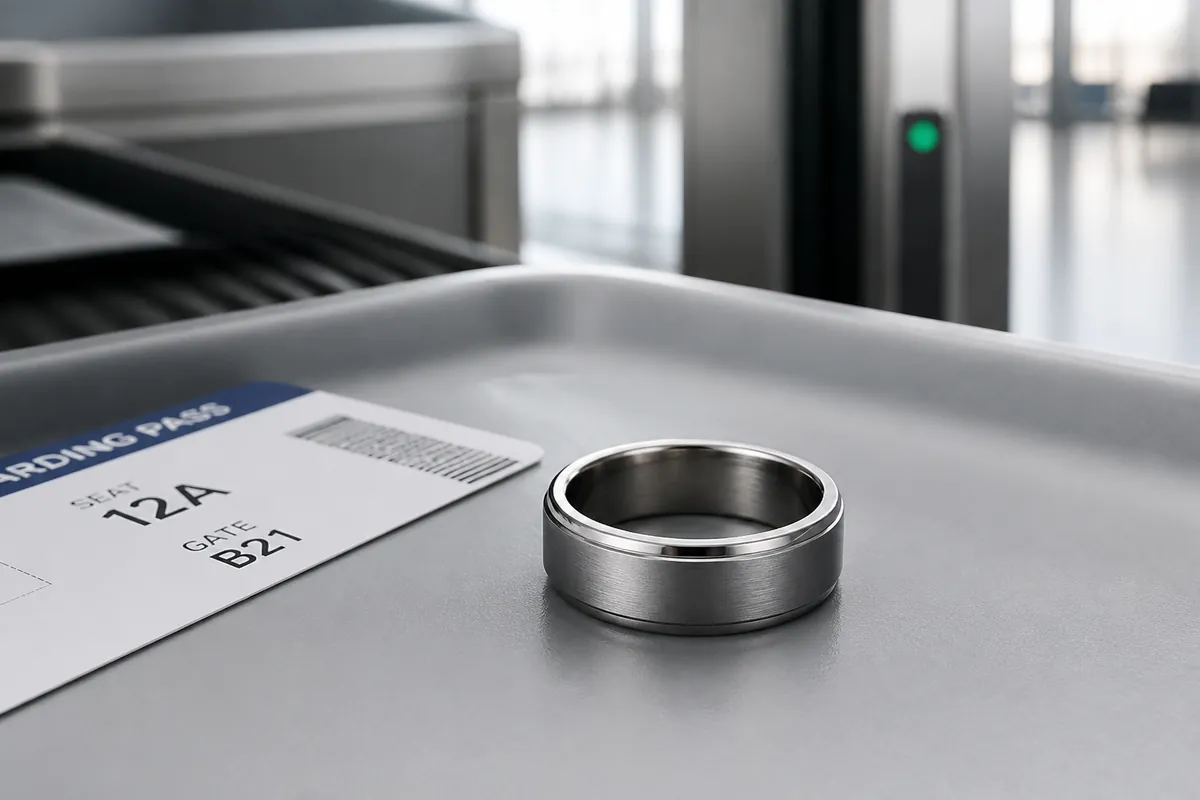
Here’s the honest answer, straight from someone who’s flown through Brisbane, Sydney, Auckland and half a dozen US airports wearing a titanium band the whole time: yes, it beeps. Every time. Titanium and tungsten are both metals, and a walk-through metal detector (the kind at every domestic and international gate) is tuned to pick up exactly that. Tungsten carbide rings, being denser and heavier than titanium, tend to trigger the alarm slightly more reliably, but both will register.
What doesn’t happen is anything dramatic. You’re not pulled aside for a bag search, you’re not asked to explain yourself, and nobody treats a ring beep as suspicious. The screening officer will usually just wave a hand-held wand over you, see it ping near your ring finger, glance at your hand, and nod you through. In busier airports like Sydney or LAX, some officers won’t even bother with the wand if they can see it’s a plain wedding band. The whole interaction adds maybe fifteen seconds to your trip through security.
This is different from what a lot of people assume. There’s an old myth that airport security “confiscates” rings or that certain metals are banned outright. That’s not true anywhere in Australia, the US, the UK or New Zealand. The Transportation Security Administration in the US explicitly lists jewellery as permitted through screening, and it doesn’t need to come off unless you’re asked directly, which is rare.
Choosing a Ring That Travels Well
If you’re buying a ring with an eye on how much you fly, or you’ve just had your first “why is my ring beeping” moment at Melbourne Airport and want to understand what’s going on, the material matters less for security purposes than you’d think. Titanium, tungsten, stainless steel, gold, platinum, they all set off the detector. There’s no metal that sneaks through undetected short of silicone, which isn’t metal at all.
What actually varies between materials is comfort, durability and how the ring behaves in day-to-day travel life, not just at the checkpoint. Titanium is roughly 45% lighter than steel and about 40% lighter than tungsten, so if you’re the type who forgets you’re wearing a ring at all, that’s a real consideration on a long-haul flight when your hands swell slightly from cabin pressure. Tungsten carbide, on the other hand, is scratch-resistant to the point of being almost immune to the wear a ring picks up from luggage handles, seatbelt buckles and hotel key cards.
If you travel constantly for work, our everyday heroes range was built with exactly this brief in mind: rings that shrug off the daily knocks of airports, gym bags and check-in counters without needing babying. Browse the tungsten rings collection if scratch resistance is your priority, since tungsten holds a polished edge longer than almost any other ring material on the market.
Styles That Handle Airports Best
Not every ring style is equally practical for someone who’s regularly in and out of security lines. A few patterns show up consistently among frequent flyers who’ve messaged us over the years.
Plain comfort-fit bands
The simplest bands are also the most airport-friendly in a practical sense, not because they beep less (they don’t) but because they’re instantly recognisable to security staff as a standard wedding ring, which speeds up that visual check after the wand. Our best-selling rings lean heavily toward this exact style for a reason.
Black tungsten and black zirconium
Black-finish rings are increasingly popular with guys who travel for work, partly because scuffs and micro-scratches show far less on a black finish than on polished silver-tone metal. If you’re clocking up lounge visits every second week, take a look at the black rings range.
Silicone travel rings
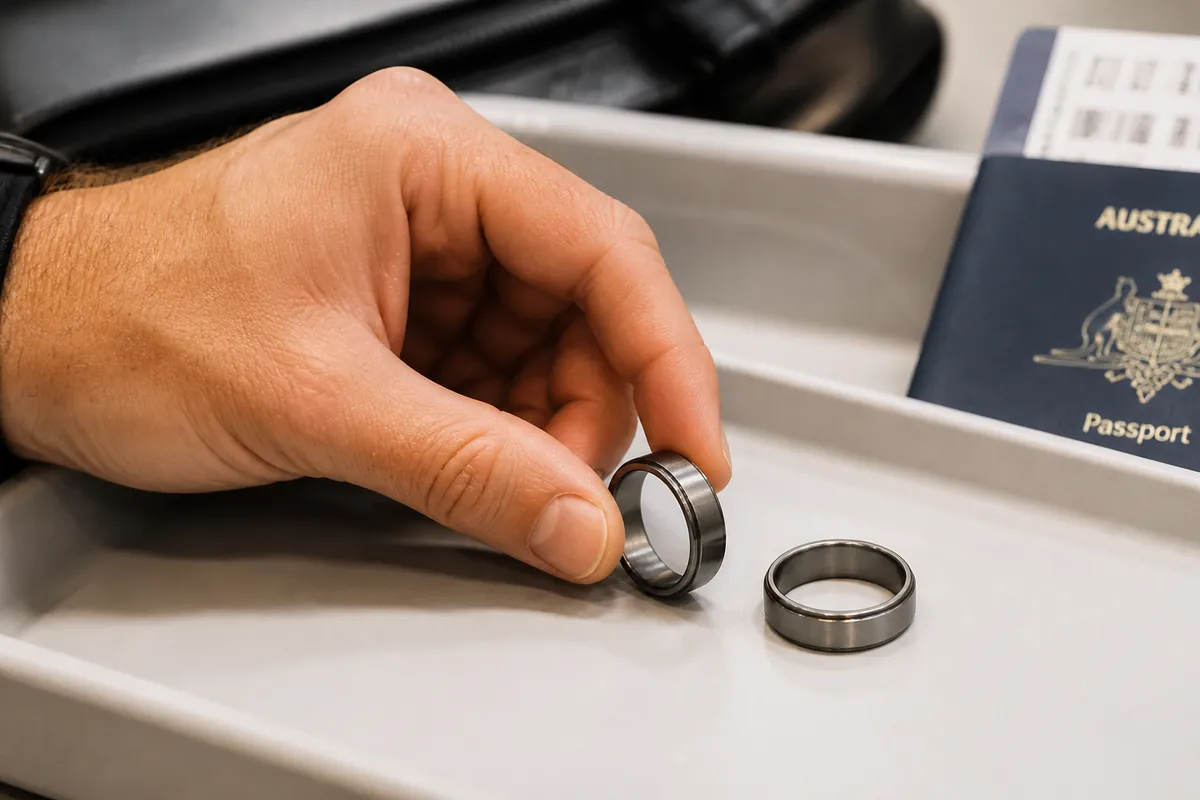
Here’s a genuinely useful trick if you’d rather avoid the beep altogether, or you’re worried about a valuable band in a hotel gym or a beach destination: pack a silicone ring as a travel backup. They’re non-metallic, so they sail through the scanner with zero fuss, and they’re cheap enough that losing one on a trip isn’t a disaster. Plenty of our customers keep one in the silicone rings collection specifically for flights, gym sessions and swimming, then switch back to their titanium or tungsten band once they land.
Ring packs for the indecisive traveller
If you like the idea of rotating between a dressy metal band at the destination and something low-key for the actual travel day, a mens ring pack gives you that flexibility without buying three separate rings at three separate price points.
What to Check Before You Buy
A few practical things matter more than most buying guides mention.
Sizing with swelling in mind. Long flights, especially anything past four or five hours, cause mild fluid retention in your hands. A ring that’s snug on the ground can feel noticeably tighter at cruising altitude. This matters more with tungsten than titanium because tungsten can’t be resized (more on that below), so get properly sized rather than guessing, ideally later in the day when your hands are at their largest.
Resizing limitations. Titanium can sometimes be resized by a small amount depending on the ring’s construction, but tungsten carbide cannot be resized at all, it’s simply too hard for a jeweller to stretch or cut without shattering it. If your weight fluctuates with travel (jet lag, time zones and hotel buffets do that to a lot of people), keep that in mind before committing to tungsten.
Whether it’s magnetic. Neither titanium nor tungsten is magnetic in its pure ring form, so neither will interfere with old-style magnetic security wands or cause issues near MRI machines the way some steel alloys can. If you’re specifically worried about interactions with electronics or medical equipment while travelling, this is one area where both materials are genuinely low-risk.
Stock availability. If you’re buying close to a trip and need something that ships fast, filter by what’s actually in stock rather than falling for a style you’ll be waiting three weeks for.
Tips From Frequent Flyers
A few things that regular travellers and jewellers both mention when this topic comes up.
First, don’t bother taking your ring off before you walk through the scanner. Removing jewellery pre-emptively actually slows the line down more than leaving it on and letting the wand handle it, according to guidance from TSA’s own screening procedures, which note that most jewellery doesn’t need to be removed at all for standard walk-through detectors.
Second, if you’re travelling with a genuinely expensive piece, a wide platinum wedding band with diamonds for instance, some frequent flyers prefer to keep it in a zipped pocket during the flight itself and only wear it at the destination, purely to avoid the small risk of catching it on an armrest or overhead locker latch. This has nothing to do with security and everything to do with basic damage prevention, similar to advice you’ll see from bridal travel guides on protecting fine jewellery in transit.
Third, body scanners (the full-body millimetre wave units you sometimes get directed through instead of the walk-through arch) will also detect a ring, but again, this triggers nothing more than a pat-down of the hand area at most, and often nothing at all since the scanner software is tuned to ignore small, expected items like wedding rings.
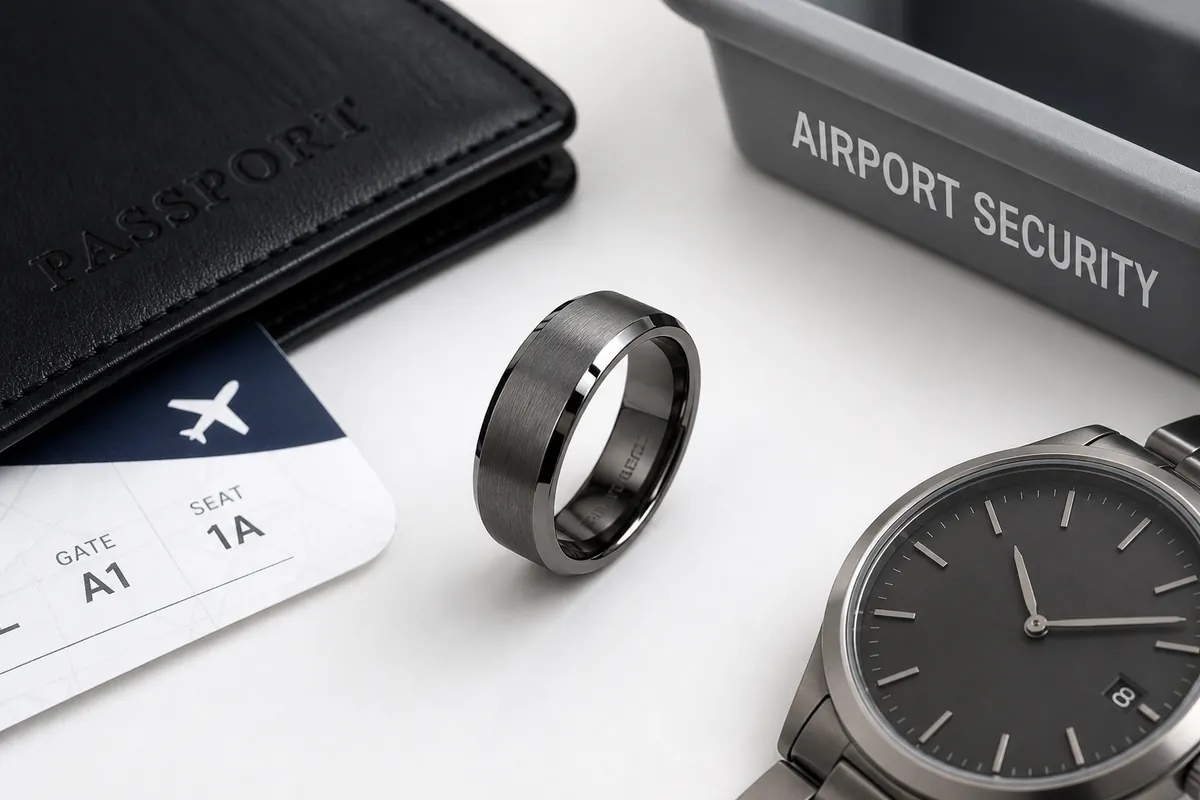
Finally, if you’re the sort of traveller who also wears cufflinks for the flight (business class does strange things to people’s dress sense), know that those will beep too, along with belt buckles, watches and anything else metallic. None of it is a problem, it’s just more wanding. Check out our cufflinks range if you’re building out a full travel-proof formal kit.
Frequently Asked Questions
Will a titanium ring set off a metal detector?
Yes, titanium is a metal and will trigger a standard walk-through detector almost every time. It’s a normal, expected beep that security staff clear in seconds with a quick wand check, so there’s nothing to worry about or prepare for.
Do I need to remove my ring at security?
No, you don’t need to remove a ring for standard screening at any Australian, US, UK or NZ airport. Leave it on and let the metal detector or body scanner do its job, security will wand or visually check your hand if needed.
Is tungsten worse than titanium at security?
Tungsten is denser and slightly more likely to register a strong signal than titanium, but the practical outcome is identical, a quick wand check and you’re through. Neither material is flagged as higher risk by security systems.
What’s the best ring style for frequent flyers?
A comfort-fit tungsten or titanium band handles the daily knocks of travel best, since both resist scratching from luggage handles and seatbelt buckles. Some frequent flyers also keep a cheap silicone ring for flights and swap back to their metal band at the destination.